I print my cheat sheet the night before my friends' draft, and there is always one name I circle before I read anything else on the page. This year it is Trey McBride, and the reason has less to do with how I feel about him than with what our own board keeps telling me every time I refresh it.
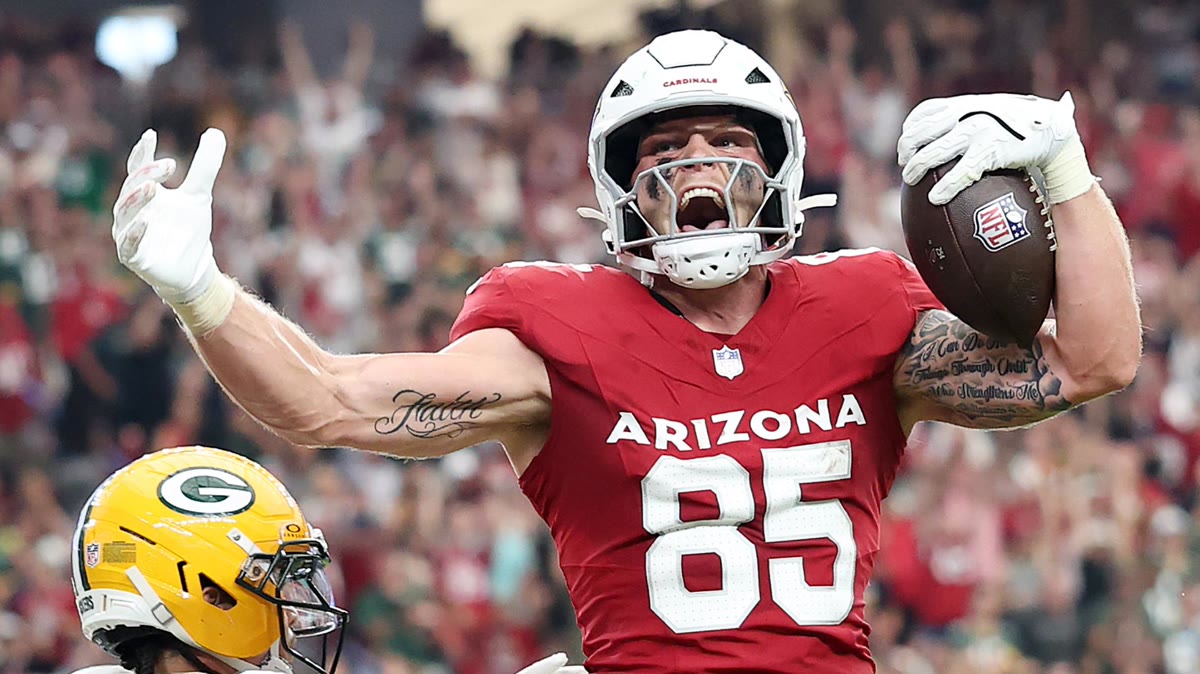
The season itself is easy to state: 126 catches for 1,239 yards and 11 touchdowns in 17 games, on 169 targets in our stat file. The record fell on Dec. 28 in Cincinnati, a 5-yard catch from Jacoby Brissett in the fourth quarter of a game the Cardinals lost 37-14, his 117th of the year and one more than Zach Ertz managed with the Eagles in 2018. He got there in his 16th game, the same number Ertz needed, and said afterward that he had not wanted anyone giving him a hard time about the extra week. In January the Associated Press panel gave him 49 of 50 first-place votes for first-team All-Pro, the first Cardinals tight end ever named to it.
Those are the numbers on the reel we put together this week, and I will admit I cut it partly so I could watch them again. What a reel cannot show is the week-to-week shape of a season, and that is where the case for him actually lives.
Our 2025 game logs have him at 315.9 points in full PPR, which works out to 18.6 a week over 17 games and put him 14th among every player in the file. The next tight end in that same file is Kyle Pitts at 210.8, a gap of 105 points, six a week, between the first tight end and the second one. McBride scored 15 or more in 10 of his 17 games and 20 or more in seven of them. He went under 10 twice, and his worst week of the year was 6.7. When people call a player safe they usually mean they like him; here it is a description of the floor.
The board we build from projections says something similar in a different language. Our value model, the one under the trade analyzer and the cheat sheet, has McBride 12th overall with a value of 46.2 on a scale where Jahmyr Gibbs is 100, a projection of 246 points and a range from 233 to 277 across the sources we blend. The names on either side of him are CeeDee Lamb and Drake London above, and Brock Bowers, James Cook and Derrick Henry below. Bowers is at 46.1 with a projection of 245.9, so the model sees the two of them as effectively the same player.
Twelfth is a strange place for a player projected 120 points behind the overall leader, and the reason is worth a minute. The model does not rank raw points, it ranks points above the last starter you could get for nothing at the same position. In a 12-team league with one tight end slot, that bar sits at 163 points for a tight end and at 186 for a running back or a receiver. Gibbs clears his bar by 180. McBride clears his by 83, less than half as much, and it still leaves him ahead of every receiver except six and every back except five.
Then comes the part that matters on draft night. The tiers on the cheat sheet are not hand-drawn. A tier breaks wherever the value drop between two neighbours is more than 5% of the value at that point, with a 3-point floor. The gap from McBride to Bowers is seven hundredths of a point. The gap from Bowers to Colston Loveland, the third tight end, is 19.5 points, by far the largest between any two tight ends on the board. Loveland sits in a tier by himself, and Tyler Warren is another 5.6 behind him in a tier of his own. Tier one at tight end is two players long.
Below that the position runs out faster than most people draft as though it does. Exactly 12 tight ends project above the replacement bar at all. Mark Andrews is the last of them at 165.5, two and a half points clear of a free agent, and by the time you reach the 18th tight end by projection, Dalton Schultz at 150.3, you are drafting someone the waiver wire can match. Set McBride's 246 against Andrews and you are looking at 80 points across the season, 4.7 a week. Against Schultz it is 96, or 5.6 a week. That is the actual price of streaming the position, and it is bigger than the number most of us carry in our heads when we say we will just find a tight end later.
Hold all of that against where the market is taking him. Across the two draft-room feeds we track, McBride's average draft position over the week ending Sept. 5 was 27.6, with a range of 25 to 30.1 across roughly 7,900 drafts, and Bowers is going at 28.9. The players coming off the board in the same stretch are Nico Collins at 22.6, Chris Olave at 25.4, Malik Nabers at 28 and Kyren Williams at 28.2, and our model values those four at 37.4, 36.2, 29.2 and 24.7. That is the whole argument in two numbers: the model has him 12th and the people actually drafting have him 28th. Loveland, one full tier down, goes at 48.3, so the market prices the drop after Bowers at about 20 picks while the value board prices it at more than 40% of McBride's worth.
Where you are sitting decides whether any of that is useful to you, and this is the part I had not thought through properly until I laid the two boards side by side. In a 12-team snake, a manager picking third comes back at 22 and again at 27. McBride's whole range sits inside that window, so the decision is a real one: at 22 or 27 the best alternatives our model offers are Olave at 36.2, Jeremiyah Love at 30.9 and Nabers at 29.2, against McBride at 46.2. Ten points of value is a lot to leave behind for the sake of positional habit. Pick first and it is cleaner still, because your second and third picks land at 24 and 25, back to back, just as his range opens.
From the other end of round one the geometry stops cooperating. A manager at 10 picks again at 15 and then not until 34. Taking McBride at 15 means reaching a dozen picks early, and waiting until 34 means he is past the top of his range and almost certainly gone. Pick 12 is worse, because your turn is 13 and then nothing until 36. That is where I would let him go without feeling bad about it, since at 13 to 17 our board already offers Drake London at 46.8 and Derrick Henry at 45.6, both going in that exact range and both carrying essentially the same value. There is no sense reaching for a tier when the slot hands you the same number anyway.
The other honest limit is what happens once the tier is empty. If McBride and Bowers are both gone, Loveland at 26.6 is not a discounted version of the same thing, and paying a tier-one price for him because tight end has become a hole is how the cliff collects a second victim.
The dynasty market reads it much the same way: eighth overall in one-quarterback leagues at 7,650 with Bowers ninth at 7,635, and the two of them seventh and ninth the other way round in superflex, where the quarterbacks push everyone down.
The early schedule is a mixed opening rather than a gift. Arizona goes to the Chargers on Sept. 13, hosts Seattle on Sept. 20, then travels to San Francisco on Sept. 27 and to the Giants on Oct. 4 before Detroit visits on Oct. 11. Our defence-versus-position file has no 2026 games in it yet and is still serving last season's numbers, so read these as 2025 and nothing more. On that basis the Chargers allowed 10.5 PPR points a game to tight ends, fifth stingiest in the league, and the Giants 11.3, both under the league median of 13.2. Seattle at 14.7 and San Francisco at 14.8 were among the ten most generous, and Detroit at 13.7 sat a shade above the middle. Week 1 is the hardest of those matchups and the ones on either side of it are not.
The Cardinals, meanwhile, have changed most of what surrounds him. Kyler Murray was released on March 11, the day the league year opened, after seven seasons. Mike LaFleur was hired as head coach on Feb. 1 from the Rams, where he had spent three seasons as offensive coordinator, and Nathaniel Hackett came in as coordinator on Feb. 13 with 10 years in that job behind him. The quarterback is Brissett, the same one who threw the record catch. He agreed to a reworked one-year, $15.5 million deal on July 26, and LaFleur said that day he would likely start Week 1, with Gardner Minshew and the rookie Carson Beck behind him. McBride himself is not going anywhere: the four-year, $76 million extension he signed in April 2025 runs through 2029 at $19 million a year, and it made him the highest-paid tight end in the league when he signed it.
Which is where the caveats sit, worth saying out loud before anyone spends a second-round pick. The projection assumes Brissett takes most of the snaps, and he is on a one-year deal with Minshew and a rookie behind him, so the man throwing McBride the ball is not a fixture. The offence is genuinely new, a head coach and a coordinator both hired in February, and 169 targets under one staff is not a commitment the next one has made. Nobody is owed a third straight season of that volume. What the model is pricing is not a promise about September, it is a floor built out of 17 games that have already happened.
Bowers, for the record, played 12 games last year and caught 64 passes for 680 yards and seven touchdowns, and the model still cannot separate the two of them, which says a great deal about Bowers and a little about which of them has 17 games of evidence behind his number.
I play in three or four leagues a year, and the one with my friends is the one I care about most. Twenty-seven picks is a long time to sit and hope. If McBride is on the board when the second round comes back around to me, I am not going to be the person who waits to find out what a tier-three tight end looks like in November.