Printable Fantasy Football Cheat Sheet
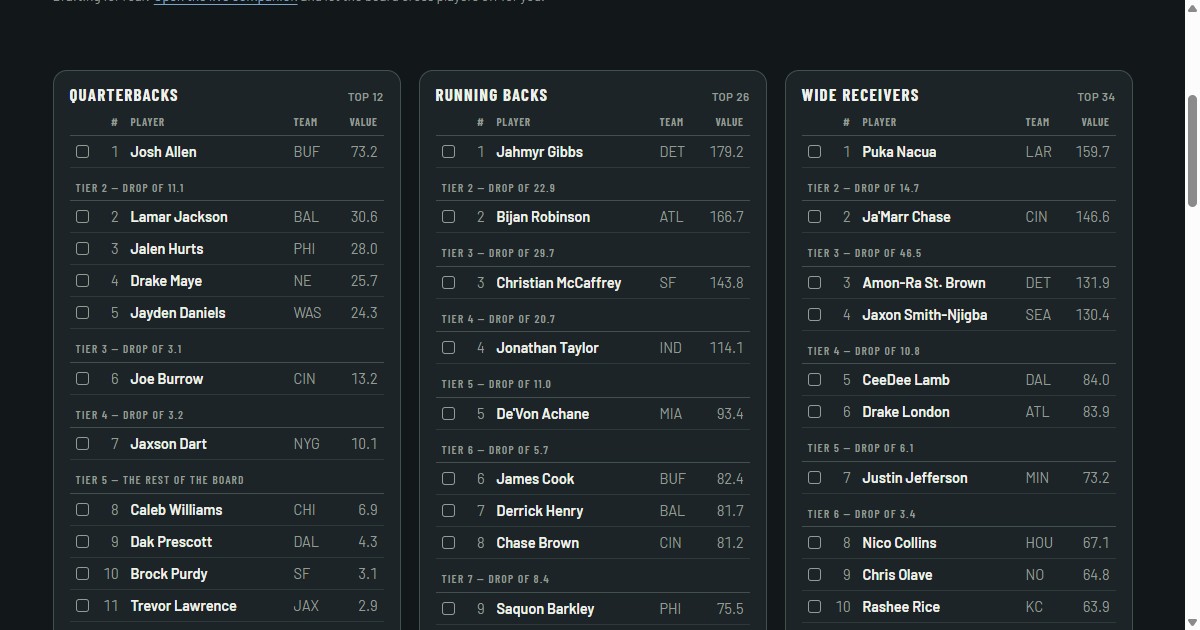
The rankings board, rebuilt for paper: tiers for your exact league, one page per position, and a checkbox beside every name so you can cross players off as they come off the board. Print it, or save it as a PDF from the same button.
Drafting for real? Open the live companion and let the board cross players off for you.
Quarterbackstop 24
| Drafted | # | Player | Team | Value |
|---|---|---|---|---|
| 1 | Josh Allen | BUF | 115.5 | |
| Tier 2 — drop of 7.7 | ||||
| 2 | Lamar Jackson | BAL | 79.6 | |
| Tier 3 — drop of 3.8 | ||||
| 3 | Drake Maye | NE | 72.0 | |
| 4 | Jalen Hurts | PHI | 71.4 | |
| Tier 4 — drop of 7.6 | ||||
| 5 | Jayden Daniels | WAS | 67.5 | |
| Tier 5 — drop of 3.4 | ||||
| 6 | Joe Burrow | CIN | 59.9 | |
| 7 | Caleb Williams | CHI | 57.9 | |
| Tier 6 — drop of 8.4 | ||||
| 8 | Dak Prescott | DAL | 54.5 | |
| 9 | Trevor Lawrence | JAX | 53.9 | |
| 10 | Brock Purdy | SF | 52.8 | |
| 11 | Jaxson Dart | NYG | 51.5 | |
| 12 | Justin Herbert | LAC | 51.3 | |
| Tier 7 — drop of 5.3 | ||||
| 13 | Patrick Mahomes | KC | 42.9 | |
| 14 | Bo Nix | DEN | 42.4 | |
| 15 | Jared Goff | DET | 40.2 | |
| 16 | Kyler Murray | MIN | 40.2 | |
| 17 | Matthew Stafford | LAR | 38.5 | |
| 18 | Tyler Shough | NO | 36.4 | |
| Tier 8 — drop of 7.0 | ||||
| 19 | Jordan Love | GB | 31.2 | |
| 20 | Malik Willis | MIA | 28.6 | |
| 21 | Baker Mayfield | TB | 26.4 | |
| Tier 9 — drop of 7.9 | ||||
| 22 | Sam Darnold | SEA | 19.4 | |
| Tier 10 — drop of 9.3 | ||||
| 23 | Bryce Young | CAR | 11.5 | |
| Tier 11 — the rest of the board | ||||
| 24 | C.J. Stroud | HOU | 2.2 | |
Running backstop 44
| Drafted | # | Player | Team | Value |
|---|---|---|---|---|
| 1 | Jahmyr Gibbs | DET | 301.6 | |
| Tier 2 — drop of 33.7 | ||||
| 2 | Bijan Robinson | ATL | 268.0 | |
| Tier 3 — drop of 25.8 | ||||
| 3 | Christian McCaffrey | SF | 234.2 | |
| 4 | Jonathan Taylor | IND | 234.1 | |
| Tier 4 — drop of 15.0 | ||||
| 5 | De'Von Achane | MIA | 208.3 | |
| Tier 5 — drop of 15.2 | ||||
| 6 | Chase Brown | CIN | 193.3 | |
| 7 | Derrick Henry | BAL | 192.1 | |
| 8 | James Cook | BUF | 189.8 | |
| 9 | Ashton Jeanty | LV | 186.8 | |
| 10 | Saquon Barkley | PHI | 185.7 | |
| 11 | Kenneth Walker III | KC | 183.4 | |
| Tier 6 — drop of 13.6 | ||||
| 12 | Omarion Hampton | LAC | 168.3 | |
| 13 | Breece Hall | NYJ | 164.1 | |
| 14 | Javonte Williams | DAL | 163.4 | |
| 15 | Bucky Irving | TB | 156.4 | |
| 16 | Cam Skattebo | NYG | 151.7 | |
| 17 | Kyren Williams | LAR | 148.0 | |
| 18 | Jeremiyah Love | ARI | 147.4 | |
| 19 | Travis Etienne | NO | 146.8 | |
| 20 | D'Andre Swift | CHI | 144.8 | |
| Tier 7 — drop of 6.3 | ||||
| 21 | Quinshon Judkins | CLE | 131.2 | |
| 22 | David Montgomery | HOU | 128.9 | |
| 23 | Jaylen Warren | PIT | 123.6 | |
| Tier 8 — drop of 7.4 | ||||
| 24 | Bhayshul Tuten | JAX | 117.3 | |
| 25 | Rhamondre Stevenson | NE | 113.9 | |
| 26 | Chuba Hubbard | CAR | 109.7 | |
| 27 | Jadarian Price | SEA | 106.7 | |
| 28 | TreVeyon Henderson | NE | 104.6 | |
| 29 | Tony Pollard | TEN | 101.2 | |
| 30 | J.K. Dobbins | DEN | 100.1 | |
| Tier 9 — drop of 7.7 | ||||
| 31 | Rico Dowdle | PIT | 92.8 | |
| 32 | MarShawn Lloyd | GB | 91.6 | |
| Tier 10 — drop of 7.0 | ||||
| 33 | Aaron Jones | MIN | 83.9 | |
| 34 | Jonathon Brooks | CAR | 81.2 | |
| 35 | Kenny Gainwell | TB | 79.4 | |
| 36 | RJ Harvey | DEN | 77.0 | |
| 37 | Rachaad White | WAS | 77.0 | |
| 38 | Kyle Monangai | CHI | 75.2 | |
| 39 | Jordan Mason | MIN | 71.5 | |
| 40 | Jacory Croskey-Merritt | WAS | 69.1 | |
| Tier 11 — drop of 7.4 | ||||
| 41 | Josh Jacobs | GB | 62.1 | |
| 42 | Blake Corum | LAR | 61.3 | |
| 43 | Tyjae Spears | TEN | 58.6 | |
| Tier 12 — the rest of the board | ||||
| 44 | Woody Marks | HOU | 51.2 | |
Wide receiverstop 44
| Drafted | # | Player | Team | Value |
|---|---|---|---|---|
| 1 | Puka Nacua | LAR | 211.0 | |
| 2 | Ja'Marr Chase | CIN | 207.1 | |
| 3 | Amon-Ra St. Brown | DET | 198.5 | |
| 4 | Jaxon Smith-Njigba | SEA | 193.7 | |
| Tier 2 — drop of 10.4 | ||||
| 5 | CeeDee Lamb | DAL | 151.7 | |
| 6 | Justin Jefferson | MIN | 150.8 | |
| 7 | Drake London | ATL | 147.5 | |
| Tier 3 — drop of 11.1 | ||||
| 8 | Nico Collins | HOU | 137.1 | |
| 9 | Chris Olave | NO | 133.4 | |
| Tier 4 — drop of 6.1 | ||||
| 10 | Rashee Rice | KC | 122.3 | |
| 11 | George Pickens | DAL | 122.3 | |
| 12 | Malik Nabers | NYG | 120.0 | |
| 13 | Garrett Wilson | NYJ | 118.2 | |
| 14 | DeVonta Smith | PHI | 117.9 | |
| 15 | Zay Flowers | BAL | 117.7 | |
| Tier 5 — drop of 5.6 | ||||
| 16 | Emeka Egbuka | TB | 111.6 | |
| 17 | Tetairoa McMillan | CAR | 108.9 | |
| 18 | Ladd McConkey | LAC | 105.2 | |
| 19 | Jameson Williams | DET | 100.9 | |
| 20 | Tee Higgins | CIN | 100.3 | |
| 21 | Jaylen Waddle | DEN | 97.1 | |
| 22 | Davante Adams | LAR | 95.4 | |
| 23 | Luther Burden III | CHI | 92.8 | |
| 24 | Christian Watson | GB | 92.0 | |
| 25 | A.J. Brown | NE | 91.6 | |
| 26 | Terry McLaurin | WAS | 91.6 | |
| 27 | Parker Washington | JAX | 90.8 | |
| 28 | Mike Evans | SF | 90.1 | |
| 29 | Rome Odunze | CHI | 88.8 | |
| Tier 6 — drop of 6.1 | ||||
| 30 | DJ Moore | BUF | 83.2 | |
| Tier 7 — drop of 6.2 | ||||
| 31 | Marvin Harrison Jr. | ARI | 77.1 | |
| 32 | DK Metcalf | PIT | 75.5 | |
| Tier 8 — the rest of the board | ||||
| 33 | Courtland Sutton | DEN | 69.4 | |
| 34 | Brian Thomas Jr. | JAX | 68.6 | |
| 35 | Alec Pierce | IND | 67.1 | |
| 36 | Jayden Reed | GB | 66.7 | |
| 37 | Carnell Tate | TEN | 63.9 | |
| 38 | Michael Pittman | PIT | 63.1 | |
| 39 | Deebo Samuel Sr. | SF | 62.5 | |
| 40 | Chris Godwin Jr. | TB | 62.1 | |
| 41 | Josh Downs | IND | 60.1 | |
| 42 | Wan'Dale Robinson | TEN | 60.0 | |
| 43 | Michael Wilson | ARI | 58.6 | |
| 44 | Jalen Coker | CAR | 57.7 | |
Tight endstop 20
| Drafted | # | Player | Team | Value |
|---|---|---|---|---|
| 1 | Trey McBride | ARI | 136.6 | |
| Tier 2 — drop of 27.8 | ||||
| 2 | Brock Bowers | LV | 119.7 | |
| Tier 3 — drop of 8.7 | ||||
| 3 | Colston Loveland | CHI | 91.9 | |
| Tier 4 — drop of 11.8 | ||||
| 4 | Tyler Warren | IND | 83.3 | |
| Tier 5 — drop of 4.4 | ||||
| 5 | Sam LaPorta | DET | 71.4 | |
| 6 | Harold Fannin Jr. | CLE | 71.1 | |
| Tier 6 — drop of 11.1 | ||||
| 7 | Travis Kelce | KC | 66.7 | |
| 8 | Kyle Pitts | ATL | 65.9 | |
| 9 | George Kittle | SF | 65.9 | |
| Tier 7 — drop of 3.7 | ||||
| 10 | Dalton Kincaid | BUF | 54.8 | |
| 11 | Tucker Kraft | GB | 54.2 | |
| 12 | Isaiah Likely | NYG | 53.0 | |
| Tier 8 — drop of 8.9 | ||||
| 13 | Mark Andrews | BAL | 49.3 | |
| 14 | Jake Ferguson | DAL | 47.0 | |
| 15 | Dallas Goedert | PHI | 46.7 | |
| Tier 9 — drop of 3.7 | ||||
| 16 | Hunter Henry | NE | 37.8 | |
| 17 | Dalton Schultz | HOU | 37.6 | |
| Tier 10 — drop of 3.3 | ||||
| 18 | Brenton Strange | JAX | 33.9 | |
| Tier 11 — drop of 6.9 | ||||
| 19 | Juwan Johnson | NO | 30.6 | |
| Tier 12 — the rest of the board | ||||
| 20 | T.J. Hockenson | MIN | 23.7 | |
Field guide
How to draft with this sheet
Print a board built for a 10-team half-PPR league, take it to a 12-team full-PPR draft, and the order in front of you is wrong by the third round. Scoring, league size and the number of quarterbacks you start each change which players are worth a pick and by how much. Set those three at the top of this page. The sheet rebuilds itself around them.
What this sheet is
What prints is the Rankings board on paper. One page per position, tier lines kept, and a checkbox beside every name so you can cross players off as the room takes them. Export CSV writes that same order to a file your league can import, with a Sleeper header and an ESPN header to choose between, since that header line is the only difference between the two files. Print it the morning of your draft rather than the week before, because depth charts and injury news keep moving the numbers underneath.
Adam, who runs MustDraft: “I still print my sheet the night before the draft with my friends and cross names off with a pen. Old habit, but it's the one league I most want to win, and a phone screen has never felt as reliable as paper in that room.”
Read the rest
Read the rest
Draft the tiers, not the ranks
The single most useful thing on this sheet is the horizontal tier lines. A tier groups players whose projected value is close enough that the difference is inside the sources' own disagreement — within a tier, take whoever fits your roster, your stack, or your gut. The line between tiers is where the real cost lives: when a tier is down to its last player and it's your pick, that player is worth more to you than the board position suggests, because the alternative is the top of a meaningfully worse group. The classic draft-day mistake is reaching across a tier line for a name you like when three players from the same tier would have come back to you a round later.
What the value number means
The number beside each player is projected points above a replacement-level starter at his position in your league — not raw projected points. That's why the sheet is sectioned by position and why comparing the number across positions is exactly what it's for: a running back at 38 genuinely projects to add more to your lineup than a quarterback at 22, even if the quarterback scores more total points. Scarcity is built in. In Superflex the quarterback numbers jump, because a second starting QB slot makes them scarce — that's the recalculation working, not a mistake. The sheet only lists players who clear zero on this number for the league you picked — the ones actually worth a draft pick — so a thin position page means the league has run out of players worth drafting there, not a bug in the sheet. Kickers and team defenses carry no projected value in this model and are left off the sheet entirely — not an oversight, the same methodology applied consistently.
How to use the checkboxes
Cross off every player as he is drafted — by anyone, not just you. The sheet's job in round nine is to show you, at a glance, which tiers still have live names. If you keep it current, "best available" stops being a memory test. Some people circle their own picks and strike through everyone else's; do whatever your pen hand can keep up with.
Why one page per position
Draft rooms move fast, and flipping a single sheet beats scrolling a merged list. Positional runs are also easier to see: when six wide receivers go in eight picks, the WR page suddenly looks bare below the current tier, and that emptiness is the signal to act — or to consciously let the run pass and take the value the room is leaving at other positions. It also means you're never hunting for a name across a hundred rows of a different position while the clock runs; the page in front of you is the only one you need until you turn it.
What this sheet is not
It's a snapshot; the date it was built from is printed on every page. Projections move daily during draft season as depth charts and injury news settle. It also can't see your league's draft room: for a live board with value and reach flags as picks come off, use the Draft Board, and to practice the whole thing first, the Mock Draft Trainer will grade the result. The projections and the value model behind every number are documented in plain language on the methodology page — no expert panel, no hidden sauce, and where the data is thin the board says so rather than guessing.
One thing a tier sheet can't show is the calendar. Keep the 2026 strength of schedule and bye-week table open beside it, so the last two starters you pencil in aren't both off in week nine.
How to use a printable fantasy football cheat sheet on draft night
A printed sheet is only as good as the pen you bring to it. Every time a player is taken, by anyone, tick his box or strike the name. Do it for all 12 teams and not only your own picks, because the sheet earns its keep by showing the true state of the board when the clock is on you. By round eight the question is which tiers still have a live name in them, and a sheet you have kept up answers that in one look down the page.
What the tier lines on this sheet mean
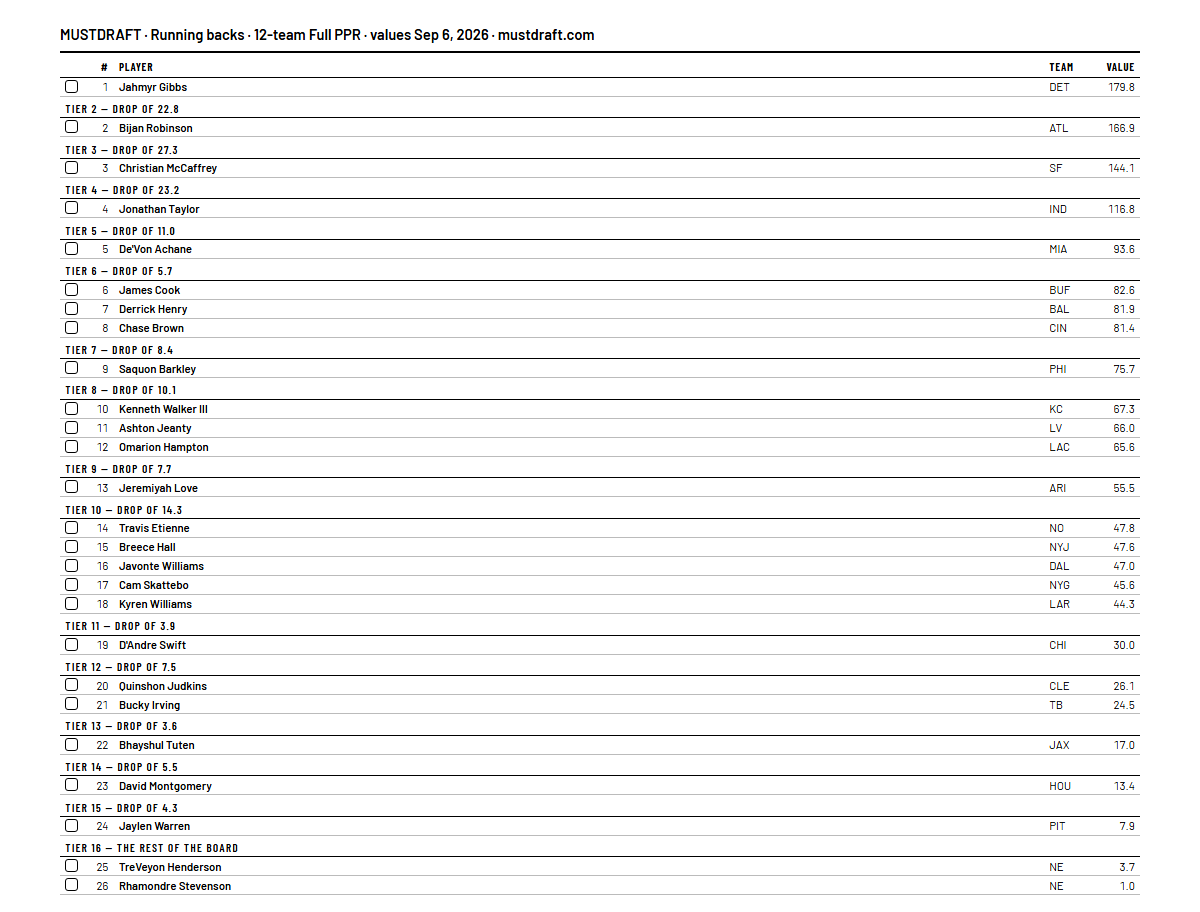
The tier bands are not anyone's opinion about who belongs together. A new tier starts wherever the projected value falls between two neighbours by more than 5 percent of the value at that point on the board, with a floor of three points. Each band prints the size of the cliff ahead of it, so a band reading "drop of 5.7" means the last player in that group is worth about six points more than the first player in the next one. The final band on each page reads "the rest of the board". Those players clear replacement level by so little that the order among them hardly matters.
Read the size of the drop rather than the tier number. A drop of three is a shrug, so take whoever fits your roster. A drop of 14 is a real decision, and it is the moment to think about reaching a round early instead of watching the whole tier vanish before your next turn.
When to put the sheet down
Paper cannot see your roster. If you hold three running backs and no receiver in round five, the best value on the RB page is not your pick, and the sheet will not say so. A page gone bare below the current tier is a fair sign a positional run just happened. Bye weeks are the other blind spot, which is why the strength of schedule table deserves a second sheet of paper. If your league carries keepers, settle them first with the keeper value calculator, then print and cross the kept players off before the first pick is made.
Why the sheet rebuilds for your league
The three settings at the top of the page change the order underneath, and by more than most people expect. Full PPR pushes pass-catching backs and slot receivers up the board. A 14-team league runs out of starting-calibre players a round or two sooner than a 10-team one, which moves the replacement line and with it every value on the page. Superflex doubles the demand for quarterbacks, and the QB page stops being an afterthought. A generic top-200 list has none of that in it. The header on every page here names the league it was built for.
What paper gets you that an app does not
Nothing on it refreshes, which is the point. A sheet on the table beside the laptop does not fight the draft app for screen space and does not need a login when the wifi drops. You see four rounds of context at once instead of one scrolling list. If you would rather have the crossing-off done for you, the draft companion is this same board with the taken players removed as you tick them.
How to import this into your league
Export CSV downloads the sheet exactly as it stands, in the column order each platform's custom-ranking import expects. Sleeper reads the lower-case header rank,name,position,team; ESPN reads Rank,Player,Pos,Team. Pick the format with the two chips beside the button before you download. Then look for the custom or imported rankings option wherever your league lets you upload a board, and hand it the file. The download is named for the format you chose, so the two never get mixed up in your downloads folder. The rank column counts upward from 1 straight down the file, and the file keeps the sheet's own order: quarterbacks first, then running backs, receivers and tight ends, each group in its tier order. The whole file is built in your browser from the rows already on this page, so nothing is uploaded anywhere and no account is involved. If a player comes back unmatched, it is usually a spelling the other site stores differently, and you can fix that one row in any spreadsheet before importing again.