Strength of Schedule
Order
Conference
Ranked by the average 2025 win percentage of each team's 2026 opponents. It's a backward-looking proxy — last year's records don't predict this year's, and it ignores injuries, roster turnover, and game order. How we calculate things.
All 32 slates
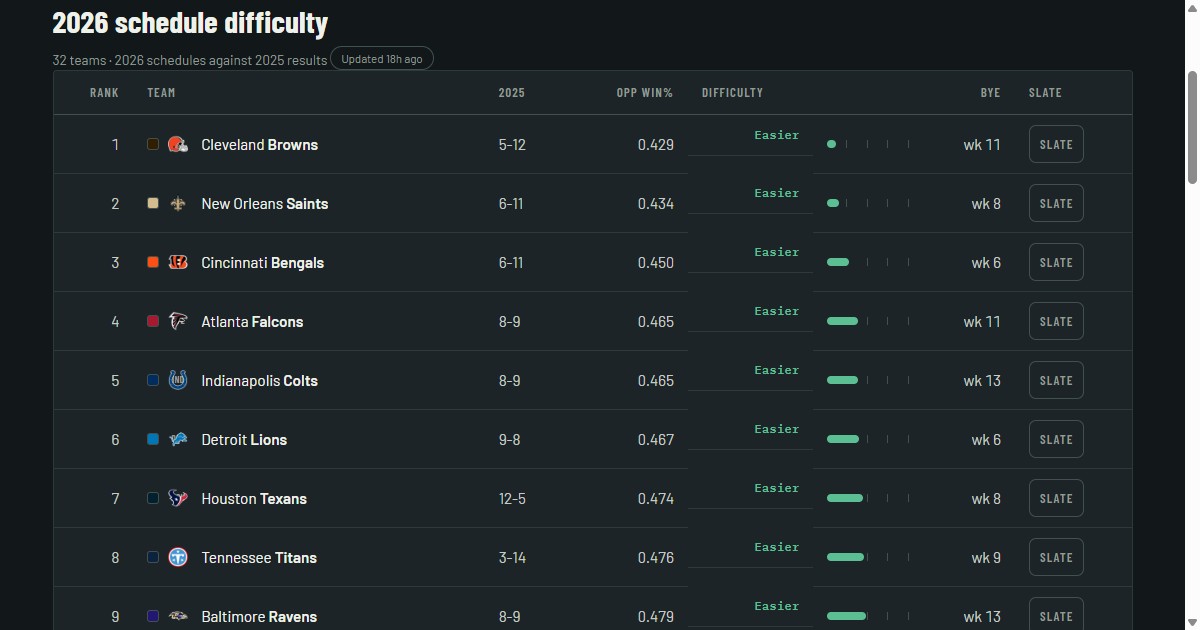
2026 schedule difficulty
| Rank | Team | 2025 | Opp win% | Difficulty | Bye | ||
|---|---|---|---|---|---|---|---|
| 1 | Cleveland Browns | 5-12 | 0.429 | Easier | wk 11 | ||
| 2 | New Orleans Saints | 6-11 | 0.434 | Easier | wk 8 | ||
| 3 | Cincinnati Bengals | 6-11 | 0.450 | Easier | wk 6 | ||
| 4 | Atlanta Falcons | 8-9 | 0.465 | Easier | wk 11 | ||
| 5 | Indianapolis Colts | 8-9 | 0.465 | Easier | wk 13 | ||
| 6 | Detroit Lions | 9-8 | 0.467 | Easier | wk 6 | ||
| 7 | Houston Texans | 12-5 | 0.474 | Easier | wk 8 | ||
| 8 | Tennessee Titans | 3-14 | 0.476 | Easier | wk 9 | ||
| 9 | Baltimore Ravens | 8-9 | 0.479 | Easier | wk 13 | ||
| 10 | Philadelphia Eagles | 11-6 | 0.481 | Easier | wk 10 | ||
| 11 | Jacksonville Jaguars | 13-4 | 0.490 | Middling | wk 7 | ||
| 12 | Tampa Bay Buccaneers | 8-9 | 0.491 | Middling | wk 10 | ||
| 13 | Dallas Cowboys | 7-9-1 | 0.493 | Middling | wk 14 | ||
| 14 | Pittsburgh Steelers | 10-7 | 0.495 | Middling | wk 9 | ||
| 15 | San Francisco 49ers | 12-5 | 0.497 | Middling | wk 8 | ||
| 16 | New York Giants | 4-13 | 0.498 | Middling | wk 8 | ||
| 17 | Washington Commanders | 5-12 | 0.502 | Middling | wk 7 | ||
| 18 | Denver Broncos | 14-3 | 0.512 | Middling | wk 10 | ||
| 19 | Seattle Seahawks | 14-3 | 0.514 | Middling | wk 11 | ||
| 20 | Los Angeles Rams | 12-5 | 0.516 | Middling | wk 11 | ||
| 21 | New York Jets | 3-14 | 0.517 | Middling | wk 13 | ||
| 22 | Minnesota Vikings | 9-8 | 0.519 | Tougher | wk 6 | ||
| 23 | Carolina Panthers | 8-9 | 0.521 | Tougher | wk 5 | ||
| 24 | Los Angeles Chargers | 11-6 | 0.523 | Tougher | wk 7 | ||
| 25 | Buffalo Bills | 12-5 | 0.528 | Tougher | wk 7 | ||
| 26 | Las Vegas Raiders | 3-14 | 0.529 | Tougher | wk 13 | ||
| 27 | New England Patriots | 14-3 | 0.531 | Tougher | wk 11 | ||
| 28 | Kansas City Chiefs | 6-11 | 0.536 | Tougher | wk 5 | ||
| 29 | Arizona Cardinals | 3-14 | 0.538 | Tougher | wk 14 | ||
| 30 | Green Bay Packers | 9-7-1 | 0.538 | Tougher | wk 11 | ||
| 31 | Miami Dolphins | 7-10 | 0.542 | Tougher | wk 6 | ||
| 32 | Chicago Bears | 11-6 | 0.550 | Tougher | wk 10 | ||


Plan around the gaps
Bye weeks
Draft two starters who share a bye and you'll be scrambling that week. Check the stacked weeks before you fill out your bench.
Field guide
How much should schedule strength move you?
Less than most draft-day arguments assume. Season-long strength of schedule is the weakest popular tiebreaker in fantasy, for a reason visible in the numbers on this page: the gap between the easiest and hardest slate in the league is usually only a handful of percentage points of opponent win rate, spread across seventeen games. That's noise next to a torn ACL, a coaching change, or a rookie who takes the job in week four.
There's a deeper problem. This ranking uses last season's records because that's the only completed evidence that exists in July — but team quality is unstable year over year. Clubs that finished badly get easier schedules, cheaper draft picks and a healthier roster, and a good share of them bounce. By November, some of the defenses that look soft here will be top-ten units, and vice versa. Treat a season-long number as a tiebreaker between two players you already rate the same, never as a reason to move someone up or down a tier.
Read the rest
Read the rest
Where it does earn its keep
Two windows matter. The first is the opening month, because early-season matchups are the closest thing to knowable — rosters haven't changed since the schedule came out, and a favourable first three games is a real edge for a streaming quarterback, a kicker, or a running back you drafted late and need production from immediately. Use the opponent lists above to check those first games specifically rather than the season average.
The second is your league's playoff weeks — typically weeks 15 through 17. That's when championships get decided, and a receiver facing three shaky pass defenses in that stretch is genuinely more valuable than one walking into a gauntlet, especially at positions you plan to stream. Look at the tail of a team's opponent list, not its average.
Byes are the one piece of schedule information that's certain, and the most actionable. Two starters on the same bye is a self-inflicted loss; a late-round backup whose bye differs from your starter's is worth more than an equal player who sits the same week. The printable cheat sheet is where that check happens on draft day — tick players off as they go and keep this table beside it.