A four-game week looks like an easy tiebreaker on the waiver wire. Then you open your lineup and find that three of those games fall on nights when every suitable slot is already taken. You can add the player, but you still have to bench somebody to use him.
Before spending a pickup, look at the nights you need to fill. For a team in a daily-lineup league, a three-game schedule can fit better than a four-game one. Portland and Houston offer a useful example in the upcoming week of October 26 through November 1, 2026.
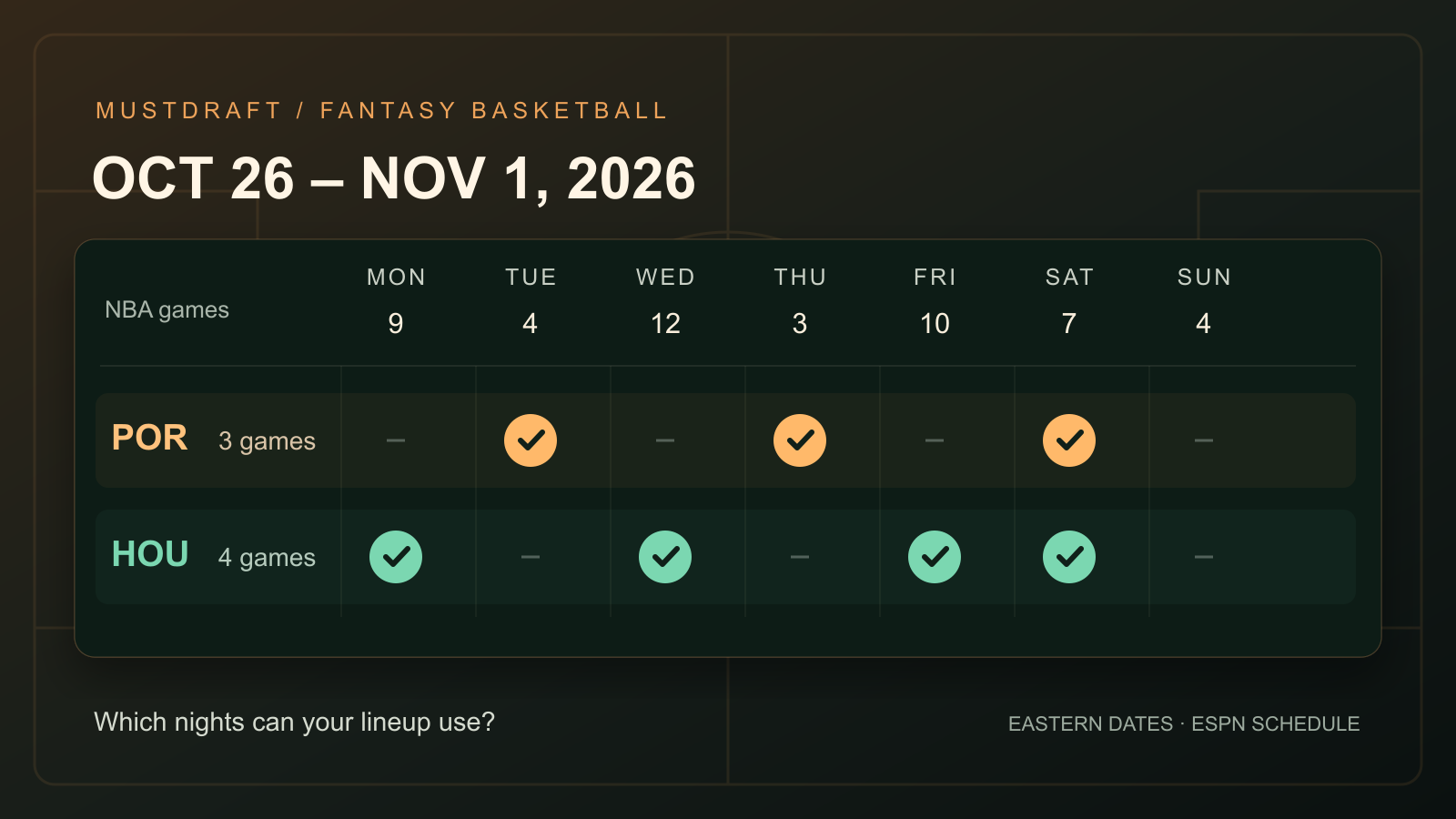
Portland plays Tuesday, Thursday and Saturday. Houston plays Monday, Wednesday, Friday and Saturday. The extra Rockets game is easy to spot in a weekly total. What that total cannot tell you is whether any of those games fit your team.
Put the two schedules beside your lineup
Here is the week, using Eastern calendar dates. The NBA column counts games across the league; the other columns show each team's opponent. “At” means an away game.
| Day | NBA games | Portland | Houston |
|---|---|---|---|
| Mon, Oct. 26 | 9 | Off | vs. Atlanta |
| Tue, Oct. 27 | 4 | at Lakers | Off |
| Wed, Oct. 28 | 12 | Off | at Milwaukee |
| Thu, Oct. 29 | 3 | vs. Memphis | Off |
| Fri, Oct. 30 | 10 | Off | at Dallas |
| Sat, Oct. 31 | 7 | at Utah | vs. Oklahoma City |
| Sun, Nov. 1 | 4 | Off | Off |
Tuesday and Thursday are the lightest nights on Portland's schedule. That makes them worth a look, although a quiet NBA night does not automatically mean your lineup has room. You could already have players in every position a particular pickup is allowed to fill.
Picture a roster with an available slot on Tuesday, Thursday and Saturday, and preferred starters filling the eligible slots on Monday, Wednesday and Friday. Assume the two available pickups have comparable roles, qualify for those openings, and can join your lineup before their first game.
In that situation, a Portland pickup has three scheduled games you could use. A Houston pickup has one: Saturday. Playing the Rocket on the other three nights would mean replacing someone you already preferred to start. His four-game week has not disappeared, but most of it offers no extra lineup coverage.
Those are opportunities to start a player, not three guaranteed appearances or a forecast of fantasy points. The distinction matters if a player is rested, gets hurt or loses minutes. For now, the schedule has helped you narrow the choice to someone whose games fit.
Start with the player you would have to bench
Open the lineup for each night before making the add. If a slot looks full, check who is occupying it. A crowded Wednesday is still useful if the pickup would be an upgrade over one of your current starters. If the incoming player would sit behind all of them, that Wednesday game adds little to the decision.
This is where a list of teams with four games can lead you astray. It answers a schedule question without seeing your roster. The same Houston player could be a good fit for a manager who needs Wednesday coverage and a poor fit for someone whose lineup is already strongest that night.
Once you know where the openings are, compare the players themselves. In a categories league, a player who helps with the categories you are chasing may be more useful than someone with broader but less relevant production. In a points league, weigh expected output in your scoring system. A calendar advantage is a reason to compare two fringe options more closely; it is not enough reason to cut a player you expect to keep all season.
Check when the pickup becomes usable
Before confirming the move, check your league's waiver processing, acquisition limit and lineup lock. An open Tuesday slot will not help if your new player becomes available on Wednesday. A weekly-lineup league also needs a different calculation because you cannot keep rearranging starters each day.
Houston has games on both Friday and Saturday in this example. Portland does not play on consecutive days that week. Treat the Rockets' back-to-back as a prompt to check player availability before locking the lineup, rather than assuming either game will be missed.
Also look beyond the first pickup if you plan to stream, meaning you use a roster spot for short-term additions during the week. Neither team plays Sunday. A manager chasing one more game that day would need another option and enough acquisitions left to make the move. Whether that is worth doing depends on the player you would lose and how the matchup stands.
Try it with your own week
The MustDraft Schedule Planner opens this Portland–Houston comparison in the day-by-day view. It shows the dates, opponents and back-to-backs. Keep your league's lineup open alongside it, since the planner does not know which slots you can fill.
For this example, start on Tuesday and Thursday, then check Saturday. If those are your gaps, Portland deserves a closer look despite having one fewer game. If your openings fall elsewhere, change the teams in the planner and look for a schedule that fits them.
That is the useful check before a waiver claim: on which nights would this player actually make your lineup?